
Thresher Shark
Alopias pelagicus
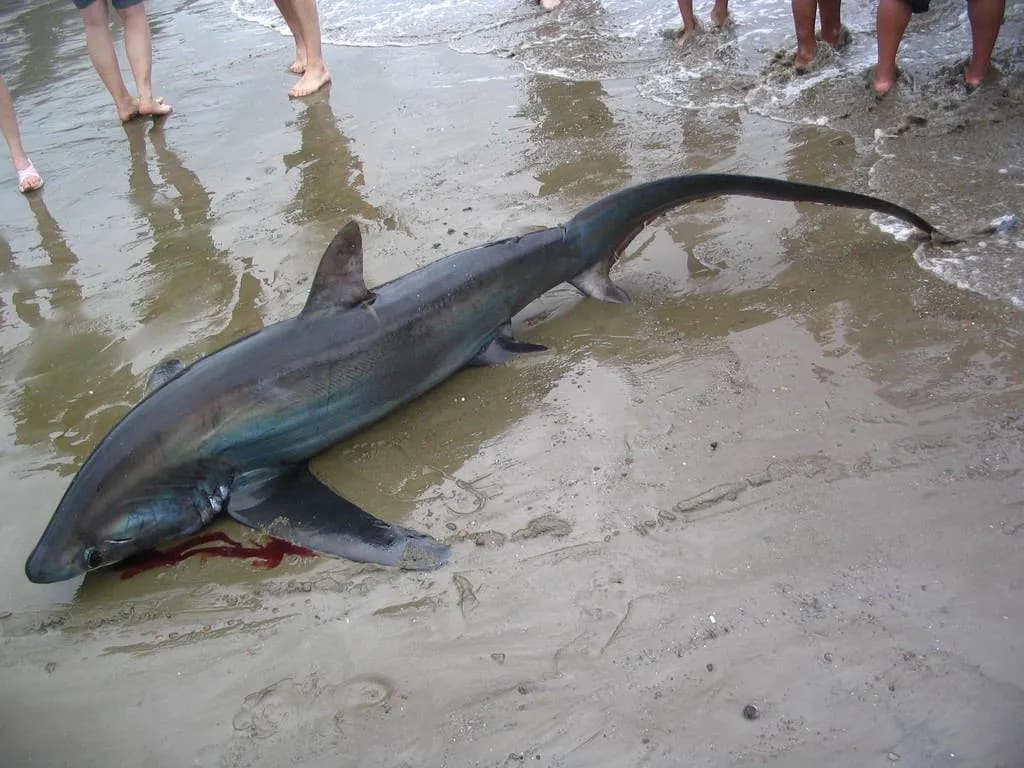
The pelagic thresher belongs to the thresher shark family (Alopiidae), a group marked by the hugely extended upper lobe of the tail fin. It lives in the tropical and subtropical waters of the Indian and Pacific Oceans, generally well offshore but sometimes moving into coastal areas. It is easily mistaken for the common thresher, even in scientific literature, but can be told apart by the dark rather than white colouring over the bases of its pectoral fins.
Family
Alopiidae
Avg Size
300-400 cm
Habitat
Because it is so often confused with the common thresher, the pelagic thresher's true range may be wider than records show. It is broadly distributed across the Indo-Pacific, with scattered sightings from South Africa, the Red Sea, and the Arabian Sea (off Somalia, between Oman and India, and off Pakistan) through to China, southeastern Japan, northwestern Australia, New Caledonia, and Tahiti, and on to the Hawaiian Islands, California, and the Galapagos. The North Pacific population moves northward during warm El Nino years, and mitochondrial DNA analysis shows considerable gene flow within the eastern and western Pacific populations but little exchange between them.
Behaviour
Little is known about how the pelagic thresher feeds. Its very slender tail and fine teeth point to a diet made up entirely of small, open-water prey, and stomach analysis confirms it feeds mainly on barracudinas, lightfishes, and escolars, all dwellers of the mesopelagic zone. This keeps it largely out of competition with other large oceanic fish-eaters such as billfishes, tunas, and dolphinfishes, which tend to feed near the surface. Like other threshers, it may circle schooling prey to herd them into a tight cluster before stunning them with a sharp strike of the upper tail lobe.
Where & When to See It
Habili Ali
Sha'ab Sharm
Abu Dabbab
Abu Kifan
Fury Shoals
Elphinstone
Salem Express
Sha'ab Samadai (Dolphin House)
Big Brother Island
Aida
Little Brother Island
Numidia