
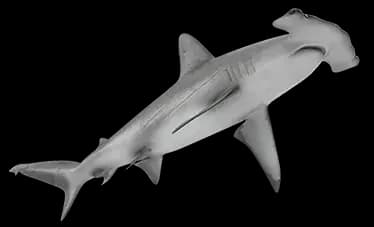
Shark · Critically Endangered
Hammerhead Shark
About
The scalloped hammerhead is a hammerhead shark in the family Sphyrnidae, originally described as Zygaena lewini. Its genus name comes from the Greek sphyrna, meaning hammer, a nod to the broad, hammer-shaped head that defines the species, with the eyes and nostrils set at the outer tips of the extensions. It is a sizeable hammerhead, yet still smaller than both the great and the smooth hammerheads.
- Family
- Sphyrnidae
- Avg size
- 300-370 cm
- Habitat
- This coastal-pelagic shark ranges over continental and island shelves and into adjacent deeper water, occurring in warm temperate and tropical seas worldwide between 46 degrees N and 36 degrees S. It can descend below 500 m but is most often above 25 m. By day it tends to stay near shore, moving further offshore to hunt at night. Adults travel alone, in pairs or in small schools, while younger animals form larger schools, and juveniles and pups favour sheltered, nutrient-rich shallows such as bays and mangroves that protect them from predators.
- Behaviour
- Scalloped hammerheads are opportunistic generalists, taking whatever prey is plentiful nearby; males and females eat the same things, though larger sharks take larger prey than juveniles do. Young sharks feed on inshore fish, while adults add larger, deeper-water animals to that diet. The bulk of their food is bony fish such as sardines, mackerel and herring, rounded out occasionally by cephalopods like squid, octopus and cuttlefish and by crustaceans such as lobsters, shrimps and crabs.
Where & when
Where & When to See It
Ras Nasrani
occasionalJun–SepMiddle Garden
occasionalJun–SepMoray Garden - Golden Blocks
occasionalJun–SepNorth Gabr El Bint
occasionalJun–SepParadise
occasionalJun–SepSha'ab Samadai (Dolphin House)
occasionalJun–SepSouth Ras Abu Galum
occasionalJun–SepThe Alternatives
occasionalJun–SepThistlegorm
occasionalJun–SepTower
occasionalJun–SepWhite Knight
occasionalJun–SepAbu Dabbab
occasionalJun–SepAbu Kifan
occasionalJun–SepAbu Nuhas
occasionalJun–SepAmphoras
occasionalJun–SepDunraven (Beacon Rock)
occasionalJun–SepEel Garden
occasionalJun–SepElphinstone
occasionalJun–SepFar Garden
occasionalJun–SepFury Shoals
occasionalJun–SepHabili Ali
occasionalJun–SepJackfish Alley
occasionalJun–SepJackson Reef
occasionalJun–SepKimon M
occasionalJun–SepKormoran
occasionalJun–SepLaguna Reef
occasionalJun–SepNapoleon Reef
occasionalJun–SepNear Garden
occasionalJun–SepNorth Ras Abu Galum
occasionalJun–SepPanorama Reef
occasionalJun–SepPinky Wall
occasionalJun–SepRas Abu Helal
occasionalJun–SepRas Bob
occasionalJun–SepRas Burg
occasionalJun–SepRas Ghamila
occasionalJun–SepRas Ghozlani
occasionalJun–SepRas Katy
occasionalJun–SepRas Um Sid
occasionalJun–SepRas Zaatar
occasionalJun–SepSalem Express
occasionalJun–SepShaab Claudia
occasionalJun–SepShaab El Erg
occasionalJun–SepShaab Sataya
occasionalJun–SepShag Rock (Kingston)
occasionalJun–SepShark & Yolanda Reef
occasionalJun–SepShark Observatory
occasionalJun–SepShark's Bay
occasionalJun–SepSiyul Kebira
occasionalJun–SepSmall Crack
occasionalJun–SepSodfa
occasionalJun–SepTemple
occasionalJun–SepThe Barge at Bluff Point
occasionalJun–SepThe Canyon
occasionalJun–SepThe Caves
occasionalJun–SepThe Islands
occasionalJun–SepThe Ulysses
occasionalJun–SepThomas Reef
occasionalJun–SepThree Pools
occasionalJun–SepTurtle Bay
occasionalJun–SepWoodhouse Reef
occasionalJun–SepBlue Hole - El Bells
occasionalJun–SepBluff Point
occasionalJun–SepCarnatic
occasionalJun–SepChrisoula K
occasionalJun–SepEel Gardens
occasionalJun–SepFiddle Garden
occasionalJun–SepGiannis D
occasionalJun–SepGordon Reef
occasionalJun–SepLighthouse
occasionalJun–SepLittle Brother Island
commonJun–SepCareless Reef
commonJun–SepNumidia
commonJun–SepBig Brother Island
commonJun–SepSha'ab Sharm
commonJun–SepAida
commonJun–SepDaedalus Reef
abundantJun–SepAbu Hashish
Shaab Maksur
El Fanadir