
Invertebrate · Least Concern
Snails
About
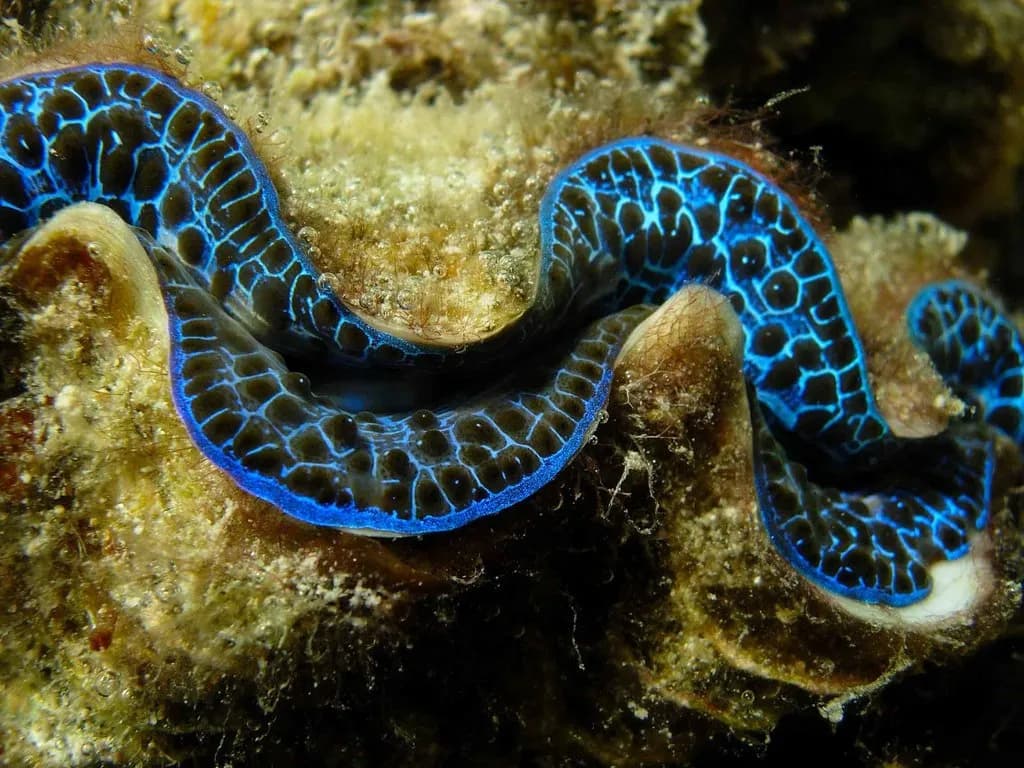
Tridacna maxima, the maxima or small giant clam, is a bivalve mollusc found throughout the Indo-Pacific region.
- Family
- Cardiidae
- Avg size
- 20-35 cm
- Habitat
- This clam has the broadest range of any giant clam, occurring around East Africa, India, China, Australia, Southeast Asia, the Red Sea, and the Pacific islands. It settles on reef surfaces or sand, or partly embedded in coral, and keeps to well-lit areas because the photosynthetic algae it depends on need sunlight.
- Behaviour
- A sessile mollusc, the small giant clam anchors itself to rock or dead coral and draws water through its body, filtering out phytoplankton and taking up oxygen through its gills. It needs to filter-feed far less than other clams, however, since most of its nourishment comes from symbiotic photosynthetic algae called zooxanthellae. It begins life as a fertilised egg that hatches within 12 hours into a free-swimming larva; this develops into a more advanced larva capable of filter-feeding, and by the third larval stage a foot appears, letting it alternate between swimming and resting on the seabed.
Where & when
Where & When to See It
Gota Soraya
occasionalYear RoundGota Kebir
occasionalYear RoundHabili Ali
commonYear RoundSha'ab Samadai (Dolphin House)
commonYear RoundSha'ab Sharm
commonYear RoundLittle Brother Island
commonYear RoundElphinstone
commonYear RoundShaab Claudia
commonYear RoundAida
commonYear RoundNumidia
commonYear RoundFury Shoals
commonYear RoundShaab Maksur
commonYear RoundAbu Ghalawa
commonYear RoundRocky Island
commonYear RoundBig Brother Island
commonYear RoundShaab Sataya
commonYear RoundShag Rock (Kingston)
commonYear RoundUmm Kharalim
commonYear RoundZabargad Island
commonYear RoundThistlegorm
commonYear RoundAbu Dabbab
commonYear RoundHabili Gaffar
commonYear RoundHamda
abundantYear RoundJackfish Alley
abundantYear RoundJackson Reef
abundantYear RoundKimon M
abundantYear RoundKormoran
abundantYear RoundMiddle Garden
abundantYear RoundNear Garden
abundantYear RoundNorth Gabr El Bint
abundantYear RoundPanorama Reef
abundantYear RoundRas Abu Helal
abundantYear RoundRas Burg
abundantYear RoundRas Disha
abundantYear RoundRas Ghamila
abundantYear RoundRas Ghozlani
abundantYear RoundRas Katy
abundantYear RoundRas Um Sid
abundantYear RoundRas Zaatar
abundantYear RoundRosalie Moller
abundantYear RoundSalem Express
abundantYear RoundShaab Abu Nugar
abundantYear RoundShaab Eissa
abundantYear RoundShaab El Erg
abundantYear RoundShaab Eshta
abundantYear RoundShaab Petra
abundantYear RoundShaab Sabina
abundantYear RoundShabrur Um Gamar
abundantYear RoundShark & Yolanda Reef
abundantYear RoundShark's Bay
abundantYear RoundSiyul Kebira
abundantYear RoundSmall Giftun
abundantYear RoundSodfa
abundantYear RoundSoma Bay Garden
abundantYear RoundSouth Ras Abu Galum
abundantYear RoundSS Turkia
abundantYear RoundTemple
abundantYear RoundThe Barge at Bluff Point
abundantYear RoundThe Canyon
abundantYear RoundThe Caves
abundantYear RoundThe Islands
abundantYear RoundThe Ulysses
abundantYear RoundThree Pools
abundantYear RoundTower
abundantYear RoundTurtle Bay
abundantYear RoundUmm Gamar North
abundantYear RoundUmm Gamar South
abundantYear RoundWhite Knight
abundantYear RoundWoodhouse Reef
abundantYear RoundAbu Kifan
abundantYear RoundAbu Ramada South
abundantYear RoundAmphoras
abundantYear RoundBelina Wreck
abundantYear RoundBluff Point
abundantYear RoundEel Gardens
abundantYear RoundFiddle Garden
abundantYear RoundGiannis D
abundantYear RoundGordon Reef
abundantYear RoundLaguna Reef
abundantYear RoundLighthouse
abundantYear RoundMoray Garden - Golden Blocks
abundantYear RoundNapoleon Reef
abundantYear RoundParadise
abundantYear RoundPinky Wall
abundantYear RoundRas Bob
abundantYear RoundRas Nasrani
abundantYear RoundShark Observatory
abundantYear RoundSmall Crack
abundantYear RoundThe Alternatives
abundantYear RoundThomas Reef
abundantYear RoundTurft El Shahed
abundantYear RoundTurtle Reef
abundantYear RoundNorth Ras Abu Galum
abundantYear RoundAbu Hashish
abundantYear RoundAbu Nuhas
abundantYear RoundAbu Ramada North
abundantYear RoundBanana Reef
abundantYear RoundBig Giftun
abundantYear RoundBlue Hole - El Bells
abundantYear RoundCareless Reef
abundantYear RoundCarnatic
abundantYear RoundChrisoula K
abundantYear RoundDaedalus Reef
abundantYear RoundDunraven (Beacon Rock)
abundantYear RoundEel Garden
abundantYear RoundEl Erug
abundantYear RoundEl Fanadir
abundantYear RoundEl Fanous West
abundantYear RoundEl Mina Wreck
abundantYear RoundErg Abu Ramada
abundantYear RoundErg Sabina
abundantYear RoundErg Somaya
abundantYear RoundFar Garden
abundantYear RoundGota Abu Ramada
abundantYear Round