
Invertebrate · Endangered
Turtle
About
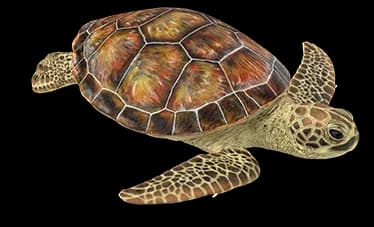
The green sea turtle, also called the green turtle, black sea turtle or Pacific green turtle, is a large sea turtle of the family Cheloniidae and the only species in the genus Chelonia. It ranges through tropical and subtropical seas worldwide, with distinct Atlantic and Pacific populations and a presence in the Indian Ocean as well. Its name comes not from its shell, which is olive to black, but from the green fat beneath the carapace produced by its strictly seagrass diet.
- Family
- Cheloniidae
- Avg size
- 100-120 cm
- Habitat
- Green sea turtles use three habitat types over their lives. They lay their eggs on beaches, while mature animals spend most of their time in shallow coastal waters with lush seagrass beds, frequenting inshore bays, lagoons and shoals rich in seagrass. Entire generations often migrate back and forth between a single pair of feeding and nesting grounds, and the species is distributed across warm tropical to subtropical waters worldwide, limited by ocean temperatures below about 7 to 10 degrees Celsius.
- Behaviour
- As one of the first sea turtles to be studied, the green turtle has shaped much of what is known about sea turtle ecology, and its way of life changes sharply between stages. Newly hatched young are carnivorous, pelagic creatures of the open-ocean mininekton, whereas immature juveniles and adults graze as herbivores in inshore seagrass meadows. Its diet shifts with age, beginning carnivorous in juveniles and becoming omnivorous as the animal matures.
Where & when
Where & When to See It
Lighthouse
commonYear RoundThree Pools
commonYear RoundTower
commonYear RoundTurft El Shahed
commonYear RoundTurtle Bay
commonYear RoundTurtle Reef
commonYear RoundUmm Gamar North
commonYear RoundUmm Gamar South
commonYear RoundUmm Kharalim
commonYear RoundWhite Knight
commonYear RoundWoodhouse Reef
commonYear RoundBluff Point
commonYear RoundEl Erug
commonYear RoundMiddle Garden
commonYear RoundNear Garden
commonYear RoundPanorama Reef
commonYear RoundRas Zaatar
commonYear RoundShag Rock (Kingston)
commonYear RoundThomas Reef
commonYear RoundShaab Eissa
commonYear RoundAbu Ghalawa
commonYear RoundAbu Hashish
commonYear RoundAbu Nuhas
commonYear RoundAbu Ramada North
commonYear RoundAbu Ramada South
commonYear RoundAmphoras
commonYear RoundBanana Reef
commonYear RoundBelina Wreck
commonYear RoundBig Giftun
commonYear RoundBlue Hole - El Bells
commonYear RoundCareless Reef
commonYear RoundCarnatic
commonYear RoundChrisoula K
commonYear RoundDaedalus Reef
commonYear RoundDunraven (Beacon Rock)
commonYear RoundEel Garden
commonYear RoundEel Gardens
commonYear RoundEl Fanadir
commonYear RoundEl Fanous West
commonYear RoundEl Mina Wreck
commonYear RoundErg Abu Ramada
commonYear RoundErg Sabina
commonYear RoundErg Somaya
commonYear RoundFar Garden
commonYear RoundFiddle Garden
commonYear RoundGiannis D
commonYear RoundGordon Reef
commonYear RoundGota Abu Ramada
commonYear RoundGota Kebir
commonYear RoundGota Soraya
commonYear RoundHabili Gaffar
commonYear RoundHamda
commonYear RoundJackfish Alley
commonYear RoundJackson Reef
commonYear RoundKimon M
commonYear RoundKormoran
commonYear RoundLaguna Reef
commonYear RoundMoray Garden - Golden Blocks
commonYear RoundNapoleon Reef
commonYear RoundNorth Gabr El Bint
commonYear RoundNorth Ras Abu Galum
commonYear RoundParadise
commonYear RoundPinky Wall
commonYear RoundRas Abu Helal
commonYear RoundRas Bob
commonYear RoundRas Burg
commonYear RoundRas Disha
commonYear RoundRas Ghamila
commonYear RoundRas Ghozlani
commonYear RoundRas Katy
commonYear RoundRas Nasrani
commonYear RoundRas Um Sid
commonYear RoundShaab Abu Nugar
commonYear RoundShaab El Erg
commonYear RoundShaab Eshta
commonYear RoundShaab Petra
commonYear RoundShaab Sabina
commonYear RoundShaab Sataya
commonYear RoundShabrur Um Gamar
commonYear RoundShark & Yolanda Reef
commonYear RoundShark Observatory
commonYear RoundShark's Bay
commonYear RoundSiyul Kebira
commonYear RoundSmall Crack
commonYear RoundSmall Giftun
commonYear RoundSodfa
commonYear RoundSoma Bay Garden
commonYear RoundSouth Ras Abu Galum
commonYear RoundTemple
commonYear RoundThe Alternatives
commonYear RoundThe Barge at Bluff Point
commonYear RoundThe Canyon
commonYear RoundThe Caves
commonYear RoundThe Islands
commonYear RoundThe Ulysses
commonYear RoundThistlegorm
commonYear RoundAbu Kifan
abundantYear RoundShaab Claudia
abundantYear RoundAbu Dabbab
abundantYear RoundZabargad Island
abundantYear RoundBig Brother Island
abundantYear RoundHabili Ali
abundantYear RoundNumidia
abundantYear RoundShaab Maksur
abundantYear RoundAida
abundantYear RoundElphinstone
abundantYear RoundRocky Island
abundantYear RoundRosalie Moller
abundantYear RoundSalem Express
abundantYear RoundSha'ab Samadai (Dolphin House)
abundantYear RoundSha'ab Sharm
abundantYear RoundFury Shoals
abundantYear RoundLittle Brother Island
abundantYear RoundMarcus